
A Research Case Study by MindBoxx Technologies
Introduction
In the modern digital economy, businesses generate enormous volumes of data from websites, mobile applications, customer interactions, transactions, marketing campaigns, and operational systems. However, data alone does not create value. The real advantage lies in transforming raw data into actionable insights that support smarter decision making.
Traditional business intelligence systems have long helped organizations analyze historical data. Yet, the complexity and scale of modern data require more advanced capabilities. This is where Artificial Intelligence (AI) powered data analytics has emerged as a transformative solution.
AI-powered analytics uses technologies such as machine learning, predictive modeling, natural language processing, and advanced data processing systems to identify patterns, forecast outcomes, and provide strategic insights.
At MindBoxx Technologies, we conducted an extensive research study to analyze how AI-driven analytics is reshaping decision making across industries. This case study explores how businesses can leverage AI analytics to improve operational efficiency, predict future trends, and gain competitive advantages.

The Data Explosion in Modern Businesses
Over the past decade, organizations have experienced an unprecedented growth in data generation.
Sources of modern business data include:
- Website analytics and user behavior
- Customer purchase transactions
- Social media engagement data
- IoT devices and sensors
- Marketing campaign metrics
- Customer support interactions
Businesses today collect more data in a single day than organizations previously generated in years.
The challenge is not data availability — it is data interpretation and strategic utilization.
Traditional analytics tools often struggle to process large datasets and uncover complex patterns. AI-powered analytics systems address this challenge by using machine learning algorithms capable of identifying insights beyond human analytical capabilities.
Growth of AI Analytics Adoption
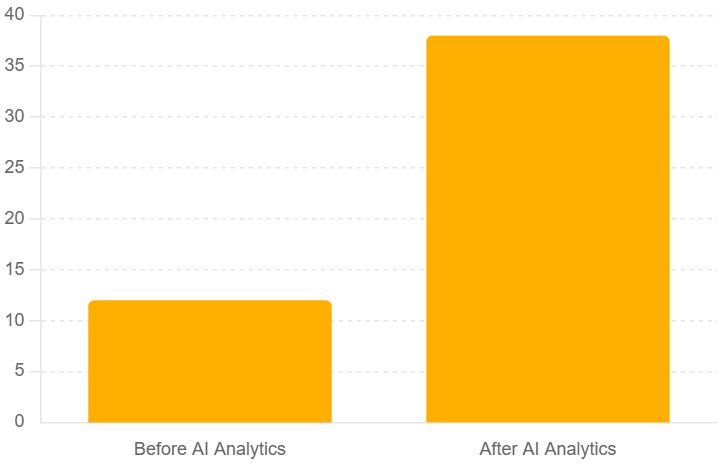
AI analytics adoption among businesses has increased rapidly over the past few years as organizations recognize the strategic value of intelligent data analysis.
The following graph illustrates the growth of AI-powered analytics adoption among businesses globally.
(Chart above: Business Adoption of AI-Powered Data Analytics)
Key observations from this trend include:
- Businesses are increasingly prioritizing data-driven strategies
- AI analytics adoption is accelerating across industries
- Organizations that leverage AI insights gain stronger competitive advantages
This growth indicates a significant shift toward data-centric business models.
What Is AI-Powered Data Analytics?
AI-powered analytics refers to the use of artificial intelligence algorithms to analyze data and generate insights that support business decisions.
Unlike traditional analytics systems, AI analytics can:
- Process large datasets in real time
- Identify hidden patterns
- Predict future trends
- Automate analytical workflows
- Generate recommendations
AI analytics systems typically incorporate several technologies.
| Technology | Function |
|---|---|
| Machine Learning | Detect patterns and improve predictions |
| Predictive Analytics | Forecast future outcomes |
| Natural Language Processing | Analyze text-based data |
| Data Mining | Extract insights from large datasets |
| Neural Networks | Model complex relationships in data |
These technologies allow businesses to move from reactive decision making to proactive strategy planning.
Types of AI Data Analytics
AI analytics can be categorized into several analytical approaches depending on the objective of analysis.
Descriptive Analytics
Descriptive analytics focuses on understanding historical data.
It answers questions such as:
- What happened?
- How did sales perform last quarter?
- What was customer engagement during a marketing campaign?
Descriptive analytics provides a foundation for further analysis.
Diagnostic Analytics
Diagnostic analytics helps businesses understand why something happened.
For example:
- Why did website traffic decline?
- Why did a product’s sales increase?
AI systems can analyze multiple variables simultaneously to identify root causes.
Predictive Analytics
Predictive analytics uses machine learning models to forecast future outcomes.
Applications include:
- demand forecasting
- customer behavior prediction
- churn prediction
- revenue forecasting
Predictive models allow businesses to make informed decisions before problems occur.
Prescriptive Analytics
Prescriptive analytics goes one step further by recommending actions based on predicted outcomes.
For example:
- recommending marketing strategies
- suggesting pricing adjustments
- optimizing inventory levels
This level of analytics helps businesses make data-backed strategic decisions.
Business Impact of AI-Driven Analytics
Organizations implementing AI analytics systems report significant improvements in operational performance and decision accuracy.
The following chart illustrates the improvement in return on investment after implementing AI analytics systems.
(Chart above: ROI Improvement with AI-Powered Analytics)
Key findings from research studies show that:
- Businesses using AI analytics experience higher ROI
- Operational costs are reduced through predictive insights
- Strategic planning becomes more accurate
AI analytics enables organizations to transform data into measurable financial value.
AI-Driven Decision Accuracy
One of the most important benefits of AI analytics is the improvement in decision accuracy.
Traditional decision making often relies on limited datasets and human judgment.
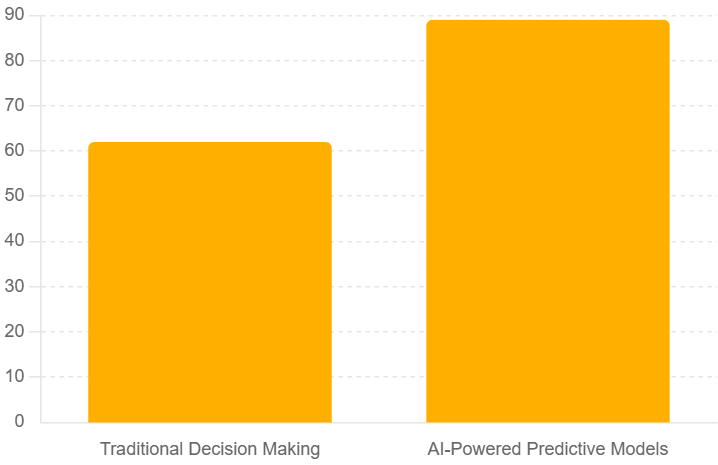
AI predictive models can analyze thousands of variables simultaneously, improving decision accuracy significantly.
The following chart demonstrates the difference between traditional decision systems and AI-driven predictive models.
(Chart above: Decision Accuracy Comparison)
This improvement highlights why organizations are increasingly relying on AI insights for strategic planning.
Industry Applications of AI Analytics
AI-powered analytics is transforming decision making across multiple industries.
| Industry | AI Analytics Applications |
|---|---|
| Ecommerce | Customer behavior analysis, product recommendations |
| Finance | Fraud detection, risk assessment |
| Healthcare | Patient data analysis, disease prediction |
| Retail | Inventory optimization |
| Manufacturing | Predictive maintenance |
| Marketing | Customer segmentation and campaign optimization |
Each of these applications demonstrates how AI analytics improves operational efficiency and strategic planning.
AI Data Analytics Architecture
A typical AI analytics system consists of several key components.
| Layer | Function |
|---|---|
| Data Collection Layer | Collects raw data from multiple sources |
| Data Processing Layer | Cleans and structures data |
| AI Modeling Layer | Applies machine learning algorithms |
| Insight Generation Layer | Produces predictions and insights |
| Visualization Layer | Displays results in dashboards |
This architecture enables businesses to transform raw data into meaningful intelligence.
Implementation Strategy for Businesses
Successfully implementing AI analytics requires a structured approach.
Step 1: Data Infrastructure Development
Businesses must first establish systems capable of collecting and storing structured data.
Examples include:
- data warehouses
- cloud data storage
- real-time data pipelines
Step 2: Data Cleaning and Preparation
AI systems require high-quality datasets.
Data preparation involves:
- removing duplicate records
- standardizing data formats
- validating data accuracy
Step 3: AI Model Development
Machine learning models are trained using historical datasets to recognize patterns.
Common AI models include:
- regression models
- classification algorithms
- neural networks
Step 4: Data Visualization and Insights
Once models generate predictions, businesses require dashboards and visualization tools to interpret insights.
Visualization platforms include:
- interactive dashboards
- predictive trend graphs
- business intelligence reports
Challenges in AI Data Analytics
Despite its advantages, AI analytics implementation presents several challenges.
Data Quality Issues
Incomplete or inconsistent datasets can reduce model accuracy.
Infrastructure Complexity
AI analytics requires advanced data infrastructure and computing resources.
Skill Shortage
Organizations often lack experienced data scientists and AI engineers.
These challenges highlight the importance of partnering with experienced technology providers.
Key Insights from the Case Study
Our research at MindBoxx Technologies reveals several important conclusions.
- Businesses that adopt AI analytics achieve faster decision cycles.
- Predictive insights significantly improve operational planning.
- AI-driven analytics improves accuracy compared to traditional decision systems.
- Data-driven organizations consistently outperform competitors.
Companies that fail to adopt intelligent analytics risk falling behind in competitive markets.
The Future of AI-Powered Data Analytics
AI analytics will continue evolving rapidly as computing power and machine learning technologies advance.
Future developments will include:
Autonomous Decision Systems
AI systems capable of making operational decisions automatically.
Real-Time Predictive Analytics
Businesses will be able to predict market changes instantly.
AI-Driven Strategy Platforms
Advanced analytics tools will assist executives in strategic planning.
Integrated Business Intelligence
AI analytics will integrate with CRM, ERP, and marketing platforms to provide unified insights.
Organizations that invest in AI analytics today will gain significant advantages in the future.
Conclusion
AI-powered data analytics is transforming the way businesses interpret information and make strategic decisions.
By leveraging machine learning algorithms, predictive models, and advanced data processing systems, organizations can uncover valuable insights hidden within massive datasets.
These insights enable businesses to:
- improve operational efficiency
- predict future market trends
- enhance customer experiences
- optimize business strategies
At MindBoxx Technologies, we believe that data-driven intelligence will become the foundation of future business success. Organizations that embrace AI analytics today will be better prepared to navigate the complexities of tomorrow’s digital economy.
Leave a comment