
A Research Case Study by MindBoxx Technologies
Introduction
Modern businesses generate large volumes of website visitors through digital marketing channels such as search engines, social media platforms, online advertisements, and email campaigns. However, attracting traffic alone does not guarantee revenue growth.
One of the biggest challenges businesses face is converting website visitors into paying customers. Many potential customers interact with a brand multiple times before making a purchasing decision.
Studies show that over 95% of website visitors leave without converting during their first interaction. This highlights the importance of nurturing potential customers through structured marketing strategies.
Marketing automation has emerged as one of the most effective solutions for converting leads into sales. By automating communication, personalizing user journeys, and tracking customer behavior, marketing automation funnels allow businesses to guide prospects through the entire decision-making process.
At MindBoxx Technologies, we conducted a research-based case study to analyze how marketing automation funnels can significantly improve lead conversion rates and generate sustainable revenue growth.
This case study explores:
- The structure of modern marketing funnels
- Challenges businesses face in converting leads
- Marketing automation strategies that improve conversions
- Real-world performance improvements through automation
Understanding the Modern Marketing Funnel

A marketing funnel represents the journey a potential customer takes from discovering a brand to becoming a paying customer.
The funnel typically consists of several stages:
| Funnel Stage | Objective |
|---|---|
| Awareness | Attract potential customers |
| Interest | Encourage engagement with content |
| Consideration | Educate and build trust |
| Decision | Convert leads into customers |
| Retention | Encourage repeat purchases |
Each stage requires different marketing strategies and communication approaches.
Without proper lead nurturing, many prospects drop out of the funnel before reaching the purchase stage.
Lead Drop-Off in Traditional Marketing Funnels
One of the biggest issues businesses face is losing potential customers at various stages of the funnel.
The chart above illustrates a typical marketing funnel scenario where only a small percentage of visitors convert into customers.
(Chart above: Typical Marketing Funnel Conversion Stages)
In this example:
- 10,000 website visitors arrive
- 2,500 become leads
- 900 become qualified leads
- Only 270 convert into paying customers
This means that 97.3% of potential customers are lost during the funnel journey.
Marketing automation helps businesses reduce this drop-off by nurturing leads at every stage.
What is Marketing Automation?
Marketing automation refers to the use of technology platforms that automate marketing workflows, customer communication, and lead management.
Instead of manually interacting with each lead, automation systems use behavioral data and predefined workflows to guide prospects toward conversion.
Key capabilities of marketing automation include:
- automated email campaigns
- behavioral lead tracking
- lead scoring systems
- personalized content delivery
- automated follow-up sequences
These systems allow businesses to maintain continuous engagement with potential customers.
Core Components of a Marketing Automation Funnel
A successful marketing automation funnel typically consists of several integrated components.
| Component | Function |
|---|---|
| Landing Pages | Capture visitor information |
| Lead Magnets | Encourage visitors to provide contact details |
| Email Sequences | Nurture leads through automated messages |
| CRM Integration | Track customer interactions |
| Lead Scoring System | Identify high-intent prospects |
| Sales Automation | Trigger sales follow-up |
Together, these components create a system that continuously guides leads toward conversion.
Lead Capture Strategy
The first step in building an automation funnel is converting anonymous website visitors into identifiable leads.
Businesses often achieve this through:
- downloadable guides and ebooks
- free trials or demos
- newsletter subscriptions
- webinar registrations
- exclusive offers
These incentives encourage visitors to provide their contact information.
Once captured, leads enter the automated nurturing system.
Lead Nurturing Through Automated Workflows
Lead nurturing is one of the most important stages in the marketing automation funnel.
Many potential customers are not ready to buy immediately. Automated workflows help maintain engagement until the prospect is ready.
Typical lead nurturing workflows include:
| Email Stage | Purpose |
|---|---|
| Welcome Email | Introduce brand and services |
| Educational Email | Provide useful insights |
| Value Email | Demonstrate product benefits |
| Case Study Email | Build credibility |
| Offer Email | Encourage conversion |
This structured communication builds trust with prospects over time.
Behavioral Marketing Automation
Modern marketing automation systems track user behavior across digital platforms.
Examples of tracked behavior include:
- website visits
- product page views
- email opens
- link clicks
- webinar participation
Based on these behaviors, the system can automatically trigger specific marketing actions.
For example:
- sending product recommendations
- offering discount codes
- scheduling follow-up emails
This behavior-driven approach significantly improves engagement.
Lead Scoring System
Lead scoring is used to identify the most promising prospects.
Each interaction with the brand increases a lead’s score.
Example scoring system:
| Action | Lead Score |
|---|---|
| Website visit | +5 |
| Email open | +10 |
| Product page visit | +15 |
| Demo request | +30 |
When a lead reaches a specific score threshold, the system notifies the sales team to initiate direct contact.
This ensures that sales teams focus on the most qualified leads.
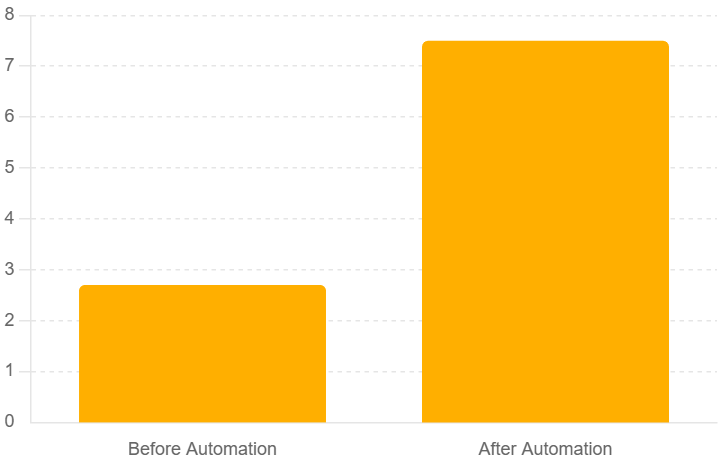
Conversion Rate Improvements with Marketing Automation
Businesses implementing marketing automation systems often experience significant improvements in conversion rates.
The chart above illustrates conversion improvements after implementing automation workflows.
(Chart above: Conversion Rate Improvement After Marketing Automation)
In this research model:
- Traditional funnel conversion rate: 2.7%
- Automated funnel conversion rate: 7.5%
This represents nearly 3X improvement in lead conversion efficiency.
Integration with CRM Systems
Marketing automation systems often integrate with Customer Relationship Management (CRM) platforms.
This integration allows businesses to maintain a unified view of customer interactions.
Benefits of CRM integration include:
- centralized customer data
- automated sales pipeline management
- improved customer insights
- better coordination between marketing and sales teams
CRM-driven automation improves both marketing efficiency and sales productivity.
Multi-Channel Marketing Automation
Modern automation funnels operate across multiple communication channels.
These channels may include:
- email marketing
- SMS notifications
- push notifications
- retargeting advertisements
- chatbot interactions
By communicating with prospects across multiple touchpoints, businesses increase the likelihood of conversion.
AI-Powered Marketing Automation
The next generation of marketing automation systems incorporates artificial intelligence.
AI-driven marketing automation can:
- predict customer behavior
- personalize marketing messages
- optimize campaign timing
- automatically adjust marketing strategies
AI-driven insights allow businesses to continuously improve their marketing funnels.
Industry Applications of Marketing Automation Funnels
Marketing automation funnels are widely used across industries.
| Industry | Automation Use Case |
|---|---|
| Ecommerce | abandoned cart recovery |
| SaaS Platforms | trial-to-paid conversion |
| Education | course enrollment funnels |
| Real Estate | property inquiry nurturing |
| Consulting | lead qualification funnels |
Each industry adapts the funnel structure to match its customer journey.
Key Insights from the Case Study
Our research highlights several important conclusions.
- Most businesses lose potential customers due to lack of lead nurturing.
- Marketing automation significantly improves engagement and conversions.
- Automated workflows allow businesses to scale marketing efforts efficiently.
- Data-driven marketing funnels outperform traditional marketing strategies.
Companies implementing automation funnels gain a strong competitive advantage in customer acquisition.
The Future of Marketing Automation
Marketing automation technology continues to evolve as artificial intelligence and predictive analytics advance.
Future developments will include:
Predictive Customer Journeys
AI systems will predict customer actions and adjust marketing strategies automatically.
Hyper-Personalized Marketing
Automation platforms will deliver highly personalized marketing messages based on behavioral data.
Real-Time Marketing Decisions
AI systems will analyze customer behavior in real time and adjust campaigns instantly.
Integrated Customer Experience Platforms
Marketing automation will integrate with customer service, CRM, and analytics platforms to create unified customer experiences.
Conclusion
Marketing automation funnels represent one of the most powerful strategies for converting leads into paying customers.
By combining automated workflows, behavioral tracking, and personalized communication, businesses can nurture prospects through every stage of the customer journey.
Organizations that adopt marketing automation gain several advantages:
- improved lead conversion rates
- increased marketing efficiency
- better customer engagement
- scalable customer acquisition systems
At MindBoxx Technologies, we believe that marketing automation is not just a marketing tool—it is a strategic system that enables businesses to build sustainable growth through intelligent customer engagement.
Leave a comment